Showing posts with label boat projects. Show all posts

Wednesday, August 09, 2006

Coho Kayak back for Repair and Refinishing


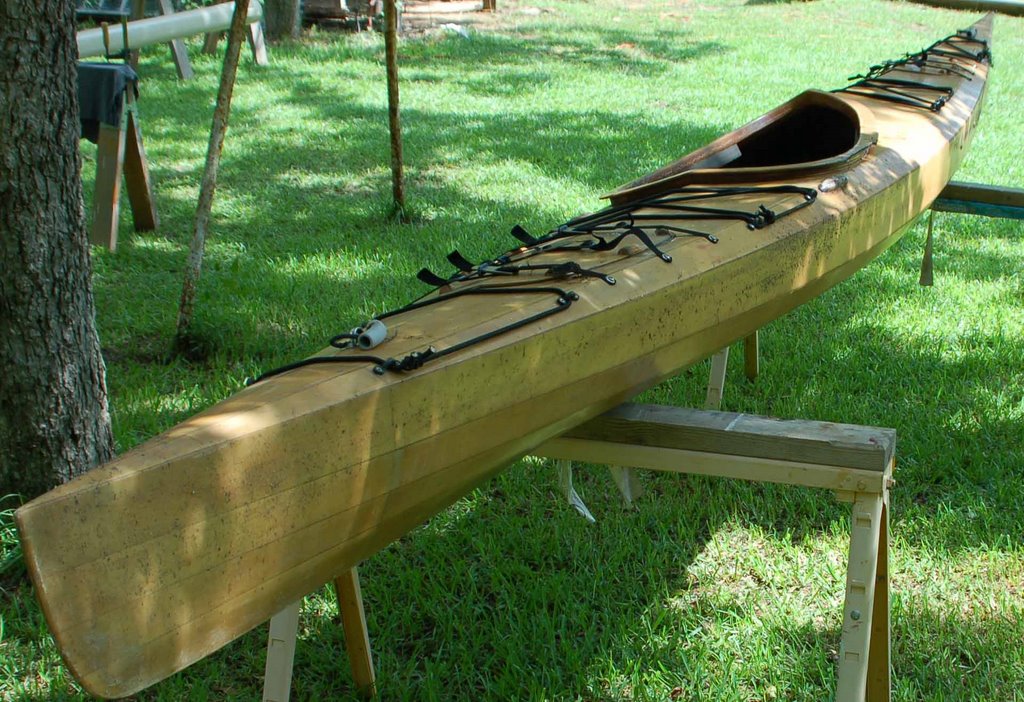
I built this Coho sea kayak from a kit by Pygmy Boats back in 1999 for my personal use. At about the same time, I also built the Pygmy Arctic Tern model, which is a hard-chined design, for my nephew Brian Nobles. I ended up selling the Coho in 2001 while I was off cruising in the Florida Keys aboard Intensity, the lucky buyer getting a great deal on a custom built wooden sea kayak because I needed cash at the time.

Brian eventually decided kayaking wasn't for him, so I bought the Arctic Tern back from him in 2003 and used it on trips such as the headwaters to the sea trip down the Pascagoula River that I did with Ernest Herndon. (For the book we wrote about this trip, go here: http://www.scottbwilliams.com/Pascagoula.html, the Arctic Tern is even on the cover.)

I never expected to see the Coho again, but last week the guy that bought it from me brought it over for repairs to a busted cockpit rim and general refinishing. I was glad to see that this boat has been used hard, as I built it extra strong for expedition paddling.

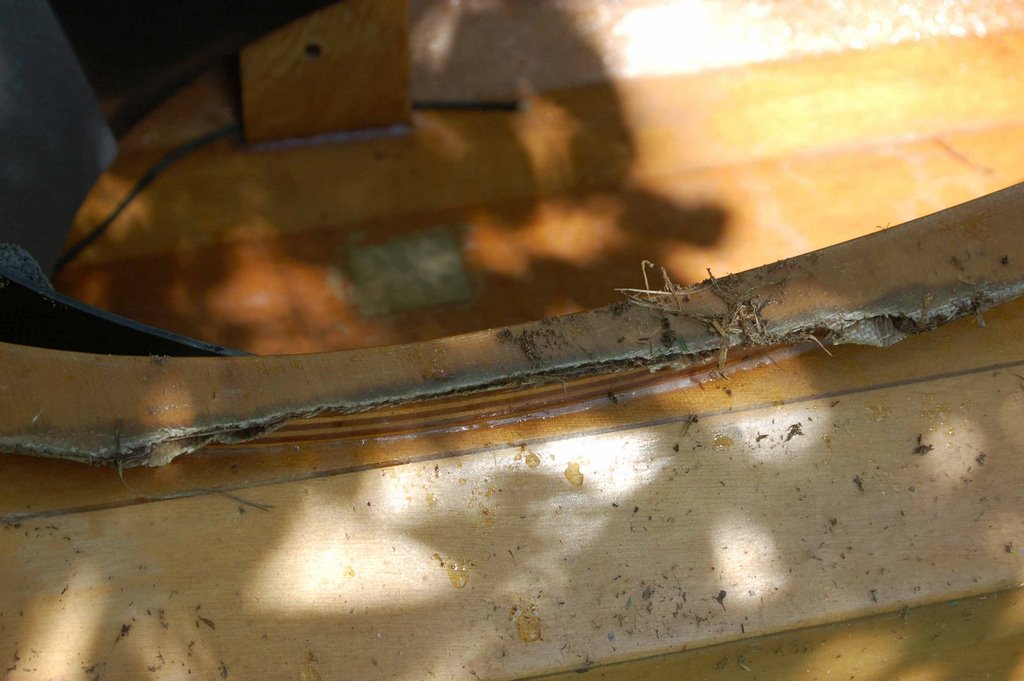
The cockpit damage was caused by driving into a too-low garage door opening with the boat on a roof rack. The owner ordered replacement parts in 4mm Okoume plywood from Pygmy Boats, so the repair would not involve fabricating any parts. I used a laminate trimming router with a panel-pilot bit to rip off the old coaming, and the new one has already been laminated on with epoxy. Next, I'll shape and glass it, then revarnish the decks and paint the hull from the sheer down. This boat has been scratched and gouged way too much for a decent varnish job on the hull, hence the paint. I think it will still look good, and will be ready for many more years of hard service.

The Coho and the Arctic Tern are both great boats, each weighing only 39 lbs., which is way lighter than any fiberglass or plastic kayak in the size range. They paddle exceptionally well, and track well without rudders, though having owned both I prefer the Arctic Tern for overall handling and tracking ability, especially in big waves or surf.

You can see my Arctic Tern here: http://www.scottbwilliams.com/Pygmykayaks.html

Or go to the Pygmy website and look at all the models they offer here:

http://www.pygmyboats.com/

You can buy the kit and build your own or hire a boatbuilder to do it for you. Pygmy boats are by far the best of the wooden kayak kits on the market, and all these kayaks are designed by John Lockwood, a serious kayaker with decades of experience who uses these boats on real expeditions.

Friday, January 20, 2006

Replacing a Bowsprit


In my last post I described a simple kind of sailing I intend to pursue on a Wharram Tiki 21, a catamaran designed with low-tech, but appropriate technology based on the traditional "double canoes" of the Pacific Islands. All Wharram catamarans are designed to be simple to build and simple to repair, even on a remote beach where tools and materials are limited.

By contrast, most modern yachts are vastly more complex and utilize hundreds of specialized and expensive fittings. Working on them requires lots of tools, and almost all repairs on such vessels are costly and time-consuming.

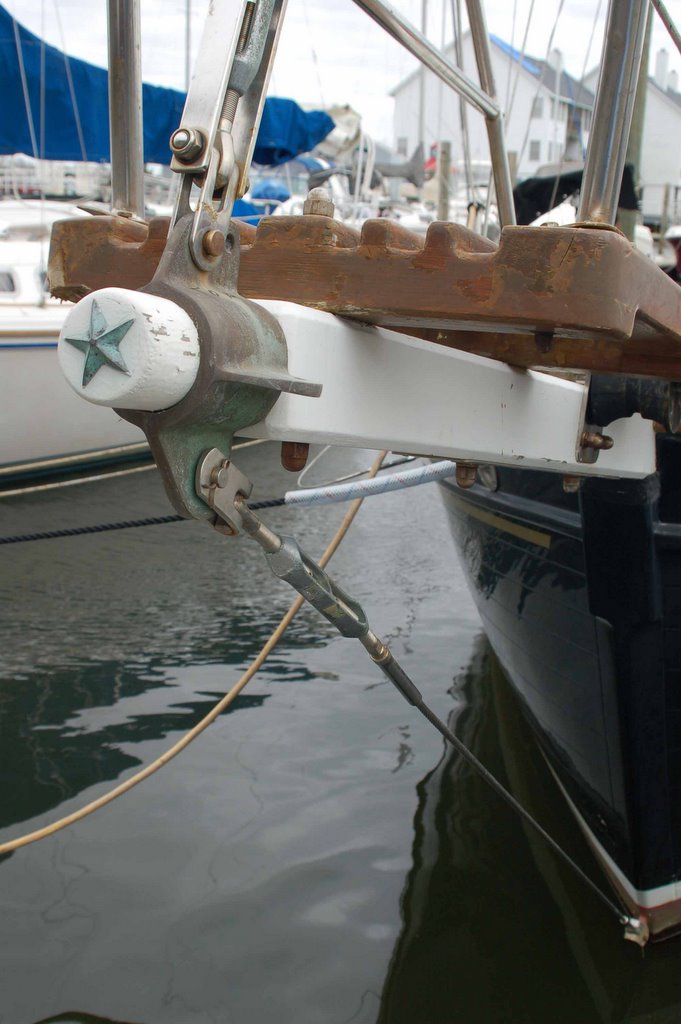
The photo above shows the bowsprit and anchor platform on a Pacific Seacraft Orion 27 Cutter, one of the finest heavy-dispacement sailing craft of it's size in the world. I spent several hours yesterday with the owner, my good friend, Artie Vaughn, working together on the difficult task of removing this bowsprit, which was cracked when it came in contact with some pilings during Hurricane Katrina. Since I'm going to use the old one as a pattern to make the replacement, I needed to get it off in one piece. After removing the bow pulpit, teak anchor platform, forestay, bobstay, whisker stays and anchor rollers, we then found that the sprit was bedded to the deck with 5200 adhesive and bolted through massive mahogany samson posts with 1/2 inch threaded rod. There was no way those samson posts were coming out without tearing half the bow off the boat, so we had to cut the threaded rod and then alternately jump up and down on the end of the sprit and winch it upward with the staysail halyard to break it free. At last it came loose with only a small fracture on the bottom side.

Today I picked up the Douglass Fir 2 x 6s I ordered to build the new sprit, which will have to be laminated to the proper thickness, then tapered down and shaped to match the old one. Making it won't be near as hard as removing it and replacing it. While I'm at it I will make a new teak anchor platform to match the old one as well.

Artie and I are both addicted sailors who can never get enough of boats, but after days like yesterday we question why we bother. The amount of work is certainly disproportionate to the fun sometimes, especially for him with his massive and complicated vessel. But, in a week or two I'll deliver that new bowsprit to him and we will somehow get it reinstalled. Then there will soon come a Spring day when he'll be on a beam reach heading out into the Gulf and all the hard work will be forgotten. And hopefully, between working on everyone else's boat I'll find time as well to put my little catamaran back together and head out myself.

Thursday, January 05, 2006

Tiki 21 Catamaran Project


I'm going back to a simpler kind of sailing for 2006 after loosing Intensity to hurricane Katrina. I've long been fascinated with James Wharram catamarans and built one of his smallest designs the Hitia 17 beachcruiser, back in 1997-98. (See a photo and description here) I had originally planned to build one of his Tiki 26 or Tiki 30 cruising catamarans, but instead bought my Grampian 26 (Intensity)and put most of my time and energy into refitting and cruising on it. The disadvantages of a deep-draft keel boat have long been apparent to me, and the lack of truly safe harbors on the Mississippi coast when a hurricane threatens is definitely one of those disadvantages.

Most multihulls are shallow draft, and Wharram catamarans are designed to really take advantage of this feature, with hull forms that require no underwater appendages such as centerboards or daggerboards to enable them to sail to weather. They can dry out on a falling tide and even the bigger ones can be sailed right up to the beach.

Although I have the building plans for the Tiki 26 and have long thought this was one of the most practical sizes for my needs, shortly after Katrina wrecked the Gulf coast I purchased a used Tiki 21 from a couple in Ocean Springs. The price was right and the catamaran came with a galvanized trailer. Trailerability was especially important to me with most of the marinas on the coast wiped out. I could bring the boat inland for a complete refit and take it back to the coast after some of the clean-up and rebuilding was done.

The Tiki 21 is an excellent beachcruiser style of boat. While too small to live aboard in the conventional manner, it does have a dry sea berth in each hull to make longer passages possible, and the expansive bridgedeck between the hulls makes a great platform to pitch a tent once the boat is anchored for the night. Although small, the Tiki 21 is a proven offshore passagemaker. It was designed as a coastal cruiser by James Wharram in the early 1980s and was never intended for long ocean passages. Despite this, a young man named Rory McDougall built one in Devon, England and left in 1991 bound for New Zealand. He eventually sailed on around the world, making the Tiki 21 the smallest catamaran in history to circumnavigate. He returned from the voyage enthusiastic about the boat, and continued to use it for shorter trips, with no desire to acquire a larger one. It takes a different sort of mentality to voyage that far on such a small, mostly open boat, but Rory's completion of the trip shows what is possible. As he said, his boat would be considered luxurious by the standards of the ancient Polynesian voyagers whose craft were Wharram's design inspiration.

Having traveled far in much smaller boats (namely canoes and sea kayaks), I'm familiar with the concept of simplicity and the advantages of carrying less and using less in the way of complex systems. The Hitia 17 that I built years ago was at the time my idea of a perfect small cruiser, but it's primary limitation was that there was no secure place anywhere on board to sleep while underway or to get out of the weather if caught out in bad conditions. It's also a bit limited in load carrying capacity for longer trips, where as the Tiki 21, with a capacity of 1,000 pounds, should have a good range for singlehanding, with room for everything one needs for this elemental form of cruising.

It seems to me that this boat, with its shallow draft of just 14 inches, stability and seaworthieness of it's deeply flared V-hulls with an overall beam of 12' and it's cruising speed of up to 10-12 knots in the right conditions, will be ideal for exploring the islands and estuaries of the Gulf coast. I can also envision cruising it among the far-flung mangrove cays of the Florida Keys and the Everglades, having a comfortable camping platform for overnight stops away from the mosquitoes and no-see-ums of the beach. A voyage across the Gulf Stream to cruise the Bahamas is certainly within its capacity for one willing to put up with a little discomfort, and such a trip is one of my goals for this boat.

Wharram catamarans are being built and sailed throughout the world, and many resources are avaiblable on the Internet for those interested in these boats. The best place to start is at the source itself: www.wharram.com for information on all the designs available. As I complete the refit and modifications of my Tiki 21, I plan to post photos and commentary here for all who are interested.

Friday, May 06, 2005

Sitka was great!

I'm back from Sitka, Alaska now, and can report that the trip and the job went smooth and turned out better than expected. Sitka is a fascinating place, an isolated little fishing community of about 9,000 people located on the Pacific side of Banarof Island, which is largely a wilderness island defined by the jagged snowy peaks of the coast range and dense conifer forests inhabited by large populations of brown bears and Sitka deer.

While there I had as my accomodations the 90-foot motoryacht, Gloria, that I went there to work on. The yacht is docked right near the heart of downtown Sitka in a municipal harbor, with fantastic views of snow-capped mountians all around. The vast majority of boats in this and other harbors in Sitka are commercial fishing vessels. Practically all the boats there, from the smallest runabouts on up are set up to handle bad weather and especially rain, most having generous dodgers or pilothouses of some sort to provide shelter for the operator. Gloria, of course, being such a large yacht, offered lavish accomodations and a large, well-equipped pilothouse high up on the bridge where the captain has a commanding view of the decks and surrounding waters.

My work involved sanding about 300 square feet of teak decks in the main aft cockpit, on the swim platform, and the steps leading up to the bridgedeck, fly bridge, and crow's nest. All the seams in these 20 steps had to be reefed out and re-caulked, adding considerable time to the job that would not have been possible to complete in the time I had there if the owner had not helped me the last three days with the work. The decks were fairly weathered, requiring us to begin sanding with 36-grit discs on the Fein 8-inch sander, but by the time we took it through the progressively finer grits of 60, 100 and 150, they looked almost new again and the owner was pleased to see that the planking was still thick enough for at least a couple more such treatments.

Deck sanding is without doubt brutally hard work, due to being on your hands and knees all day and handling powerful vibrating sanders. But despite 8-9 hours of this everyday, I still found the energy to go hiking every evening after dinner. The good thing about Sitka being located at 57 degrees north is that at this time of year daylight lasts until after 9 p.m. I used the last two hours of light every day to explore a different trail.

More about the outdoor recreation opportunities around Sitka in an upcoming post after I write an article about the area for South Mississippi Outdoors and Recreation.