Showing posts with label boatbuilding. Show all posts
Showing posts with label boatbuilding. Show all posts
Wednesday, January 31, 2007
Tiki 26 Construction has Begun!
I have now begun construction of my next cruising boat, the Wharram Tiki 26 catamaran that will become Element II. I will continue sailing the Tiki 21 Element in the meantime, as the building of the larger boat will certainly be a part-time endeavor as I work on it around my other projects for paying customers. I've started a separate blog about the construction for those who are interested. Go to: http://tiki26element2.blogspot.com where you can read all about it.


Wednesday, August 09, 2006
Coho Kayak back for Repair and Refinishing
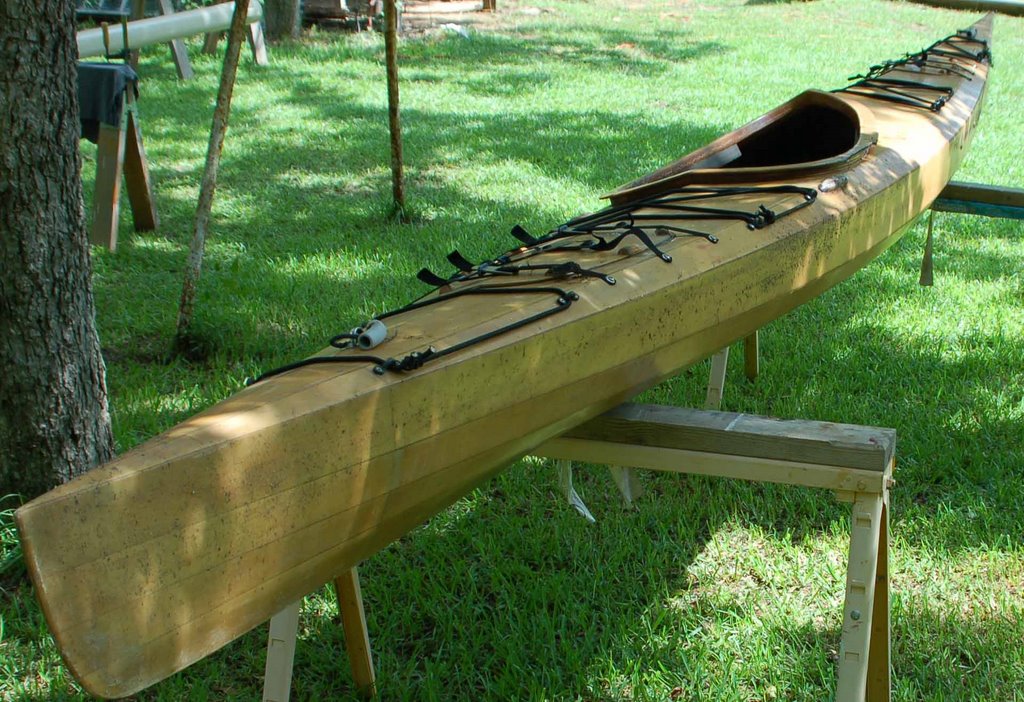
I built this Coho sea kayak from a kit by Pygmy Boats back in 1999 for my personal use. At about the same time, I also built the Pygmy Arctic Tern model, which is a hard-chined design, for my nephew Brian Nobles. I ended up selling the Coho in 2001 while I was off cruising in the Florida Keys aboard Intensity, the lucky buyer getting a great deal on a custom built wooden sea kayak because I needed cash at the time.
Brian eventually decided kayaking wasn't for him, so I bought the Arctic Tern back from him in 2003 and used it on trips such as the headwaters to the sea trip down the Pascagoula River that I did with Ernest Herndon. (For the book we wrote about this trip, go here: http://www.scottbwilliams.com/Pascagoula.html, the Arctic Tern is even on the cover.)
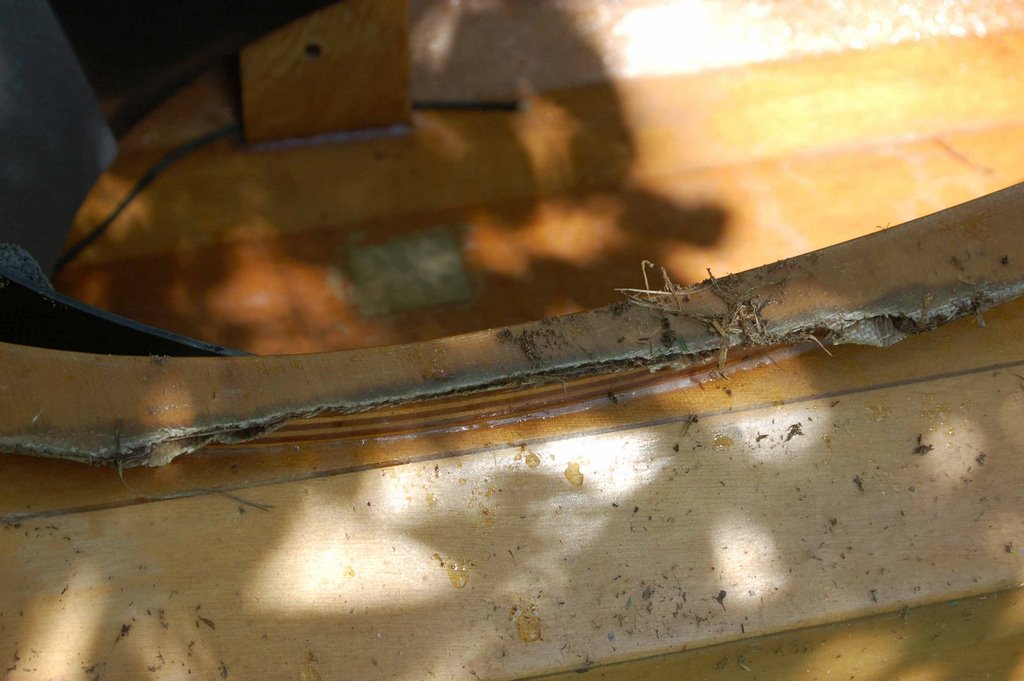
I never expected to see the Coho again, but last week the guy that bought it from me brought it over for repairs to a busted cockpit rim and general refinishing. I was glad to see that this boat has been used hard, as I built it extra strong for expedition paddling.
The cockpit damage was caused by driving into a too-low garage door opening with the boat on a roof rack. The owner ordered replacement parts in 4mm Okoume plywood from Pygmy Boats, so the repair would not involve fabricating any parts. I used a laminate trimming router with a panel-pilot bit to rip off the old coaming, and the new one has already been laminated on with epoxy. Next, I'll shape and glass it, then revarnish the decks and paint the hull from the sheer down. This boat has been scratched and gouged way too much for a decent varnish job on the hull, hence the paint. I think it will still look good, and will be ready for many more years of hard service.
The Coho and the Arctic Tern are both great boats, each weighing only 39 lbs., which is way lighter than any fiberglass or plastic kayak in the size range. They paddle exceptionally well, and track well without rudders, though having owned both I prefer the Arctic Tern for overall handling and tracking ability, especially in big waves or surf.
You can see my Arctic Tern here: http://www.scottbwilliams.com/Pygmykayaks.html
Or go to the Pygmy website and look at all the models they offer here:
You can buy the kit and build your own or hire a boatbuilder to do it for you. Pygmy boats are by far the best of the wooden kayak kits on the market, and all these kayaks are designed by John Lockwood, a serious kayaker with decades of experience who uses these boats on real expeditions.
Friday, May 06, 2005
Gulf Coast Wooden Boat Show: May 14-15
The annual Gulf Coast Wooden Boat Show will be held the weekend after next, May 14-15 at Point Cadet Marina in Biloxi. The show opens at 10 a.m. on Saturday until 6 p.m., and again from 10 a.m. Sunday until 5 p.m.
Larger wooden boats on display at the show will be docked at A-pier in the marina, which is all the way to the east end. Small trailerable boats, canoes and kayaks, and vendor booths will be set up on the grounds north of A-pier and behind the J.L. Scott Aquarium.
I'll be there signing books: Exploring Coastal Mississippi, Astray of the Herd, and On Island Time, and Michelle will be there at my booth selling some of her hand-crafted jewelry and sterling silver jewelry from Mexico. Capt. Charley (see previous post about Traditional Marlinspike Seamanship) will also have some of his ropework on display at our booth and will be taking orders for rope matts, Turks Head's, etc.
This is a good opportunity to come out and look at some beautiful boats, and maybe even buy one if you've got some extra bucks you need to get rid of.
Larger wooden boats on display at the show will be docked at A-pier in the marina, which is all the way to the east end. Small trailerable boats, canoes and kayaks, and vendor booths will be set up on the grounds north of A-pier and behind the J.L. Scott Aquarium.
I'll be there signing books: Exploring Coastal Mississippi, Astray of the Herd, and On Island Time, and Michelle will be there at my booth selling some of her hand-crafted jewelry and sterling silver jewelry from Mexico. Capt. Charley (see previous post about Traditional Marlinspike Seamanship) will also have some of his ropework on display at our booth and will be taking orders for rope matts, Turks Head's, etc.
This is a good opportunity to come out and look at some beautiful boats, and maybe even buy one if you've got some extra bucks you need to get rid of.
Tuesday, February 22, 2005
Documenting the Construction of a Mississippi Backwoods Drifter
The Mississippi Backwoods Drifter is a boat I designed in 1998 after much discussion with my long-time canoeing and camping buddy, Mississippi author and outdoor writer, Ernest Herndon. Ernest and I often discussed and compared the relative merits of canoes and the ubiquitous johnboats that are so common in Mississippi. Ernest had floated rivers in both types of craft, but preferred the canoe because the johnboats in common use are generally too big and too heavy for twisting creeks, and don't paddle well because of the wide, squared-off stern that is designed to accommodate an outboard motor. Early johnboats, commonly used throughout the south before the invention of outboard motors, were generally narrower and like a canoe, were double-ended, or symmetrical, though still squared off in an upswept pram-bow shape like the bows of modern johnboats.
Being double-ended, these boats were much easier to paddle, and lack the drag that the wide flat stern of a motor boat creates. The boat tapers back symmetrically to the stern the same as a canoe, so the stern paddler is sitting in a position that gives better access to the water for guide strokes and other maneuvers that would be difficult in a wide-sterned johnboat.
So why a flat-bottomed, pram-ended boat rather than a traditional canoe? What are the advantages? There is no question that the traditional canoe derived from northwoods Native American design is one of the best boats ever devised for a wide variety of conditions. Canoes are equally at home on lakes and rivers of most sizes, but canoes that are long enough to efficiently travel on windswept lakes or carry enough gear for expedition length trips are a bit unwieldy on some of the fast running, twisting creeks of south Mississippi that Ernest and I like to explore. By eliminating the sharp ends that enable a canoe to so efficiently cut through wind-driven waves on more open waters, the Backwoods Drifter's double pram ends allow almost the same load-carrying ability in a much shorter 12-foot length. The flat bottom allows standing and poling as well, which is also tricky in a canoe. The Backwoods Drifter can spin 180 degrees in its own length, making tricky maneuvers a breeze without the risk of capsize that would be more likely in a canoe. All in all, it's a great boat for what it is designed for, and it can be easily carried in the bed of a pickup to the launch site without the need for rooftop racks like longer canoes and kayaks.
Being double-ended, these boats were much easier to paddle, and lack the drag that the wide flat stern of a motor boat creates. The boat tapers back symmetrically to the stern the same as a canoe, so the stern paddler is sitting in a position that gives better access to the water for guide strokes and other maneuvers that would be difficult in a wide-sterned johnboat.
So why a flat-bottomed, pram-ended boat rather than a traditional canoe? What are the advantages? There is no question that the traditional canoe derived from northwoods Native American design is one of the best boats ever devised for a wide variety of conditions. Canoes are equally at home on lakes and rivers of most sizes, but canoes that are long enough to efficiently travel on windswept lakes or carry enough gear for expedition length trips are a bit unwieldy on some of the fast running, twisting creeks of south Mississippi that Ernest and I like to explore. By eliminating the sharp ends that enable a canoe to so efficiently cut through wind-driven waves on more open waters, the Backwoods Drifter's double pram ends allow almost the same load-carrying ability in a much shorter 12-foot length. The flat bottom allows standing and poling as well, which is also tricky in a canoe. The Backwoods Drifter can spin 180 degrees in its own length, making tricky maneuvers a breeze without the risk of capsize that would be more likely in a canoe. All in all, it's a great boat for what it is designed for, and it can be easily carried in the bed of a pickup to the launch site without the need for rooftop racks like longer canoes and kayaks.
I am currently building a Backwoods Drifter for a customer in east Texas, and I am documenting the entire construction process so that I can produce a complete set of plans with photos that will soon be available for sale for those who want to build their own boat. I will post regular updates and photos here during the construction of this particular Backwoods Drifter.
More info and photos of finished boats are available at: www.scottbwilliams.com/drifter.html
Subscribe to:
Posts (Atom)

