Thursday, October 20, 2005

Paddling the Pascagoula Book Cover


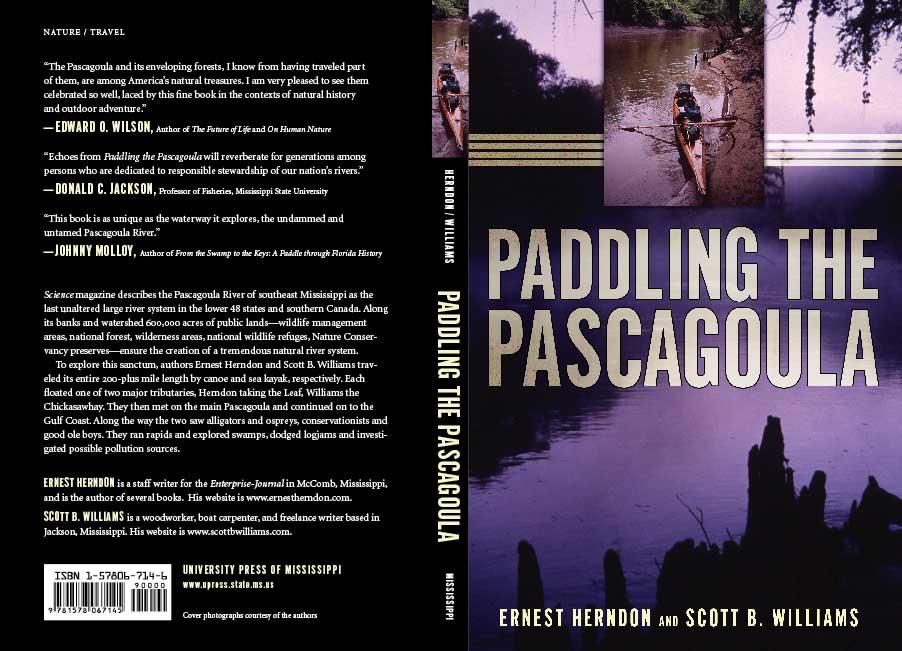
I just received a photo of the cover of my newest book, Paddling the Pascagoula, which I co-authored with Ernest Herndon. The book is a narrative of our trip from the headwaters of the Pascagoula River system to the Gulf. More about the book and more photos from the trip can be found here: http://www.scottbwilliams.com/Pascagoula.html

The main background image on this cover is a photo I took at dawn from one of my campsites on the Chickasawhay River. The inset is a photo I took of my wooden Arctic Tern sea kayak at a lunch stop near Waynesboro.

The book should be available sometime early next month.

Last Visit to Intensity

Yesterday I made one more trip to Discovery Bay to salvage a few more items off of Intensity. It's been awhile since my last post, but Ernest Herndon and I went looking for my boat in his canoe and found it after paddling up the canal from the marina and then hiking/wading across the marsh to the back side of the dense woods adjacent to the marina basin. Being dark green, the boat is hard to spot in the surrounding vegetation.

When we found her that day, I discovered that looters had broken in and taken a few items, but there was still a lot of gear on board that we were able salvage; much of it will be useful on another boat at some point. A few weeks passed and I decided to go back with tools and try to remove more stuff, particularly hardware and other useful equipment that was bolted down.

I knew when I first found the boat jammed between two pine trees where it was that it would not be sensible to try to salvage and repair it. The storm surge was reported to be 30 feet high in this area, and it's obvious by the fact that the boat was carried through the tree tops before being dropped where I found it by the receding water. A section of my mast was hanging from the top of one of the trees, the rigging caught on branches at least 50-60 feet above the ground.
The rest of the mast was lying across the cabin top, the mast tabernacle torn out through the deck. Besides dismasting, the bow pulpit and several of the stanchions were torn off, as well as the port sheet winch. The rudder shaft was bent and the tiller post pushed down through the cockpit floor. The hull is still sound, a testimony to the solid construction of old Grampian boats. But as anyone who has ever built or rebuilt a sailboat knows that a hull is only a small percentage of a cruising vessel. I knew it was time to move on to the next boat and the only thing to do was salvage what I could and cut my losses.

Yesterday's trip was successful, in that I got just about everything on the list that I made in advance. The whole Discovery Bay area is a scene of utter destruction, and even now there has been no effort at clean up. A few boats have been removed, but those in the woods like mine are still just as they were after Katrina left them there. The place was deserted yesterday and eerily silent as I worked alone in the woods and rowed back across the bayou in my heavily loaded dinghy. I suspect it'll be a long time before I return to this backwater yacht basin that was home to my boat for so many years.

Monday, September 19, 2005

Discovery Bay Marina Wiped Out


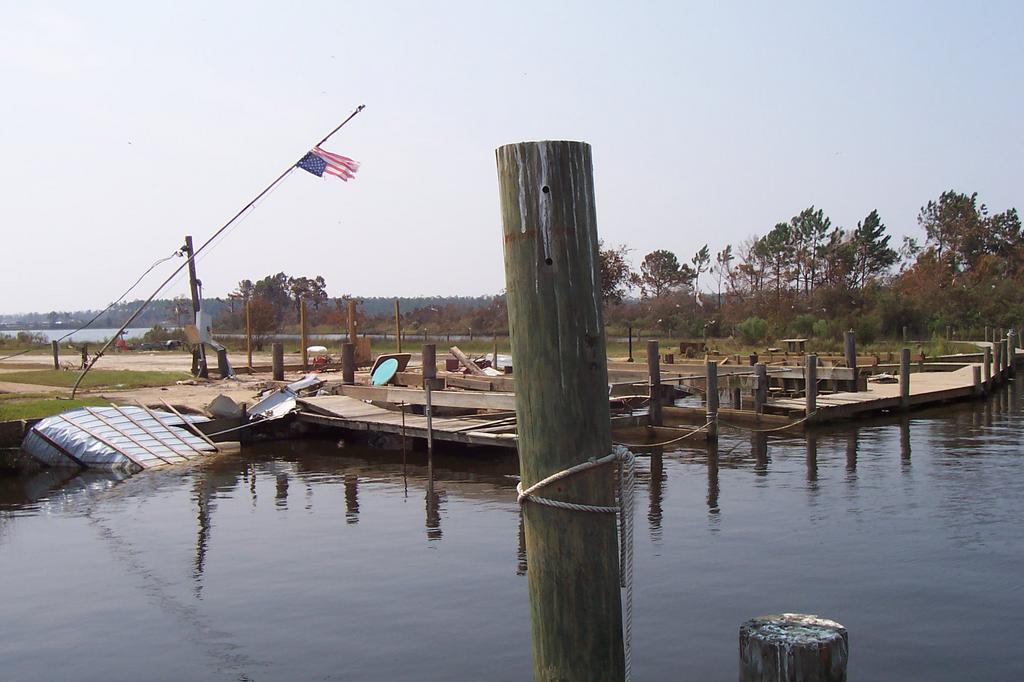
This is all that remains of the bar and grill at Discovery Bay Marina.


One of my favorite little funky marinas and backwater bars on the Mississippi coast was Discovery Bay Marina. I've had a long association with this place, having kept my boat there on and off since I bought her in 1999. Hurricane Katrina's storm surge swept Bayou Portage clean, leveling the bar and carrying most of the boats in the marina into the surrounding woods and marsh.

My boat, Intensity, was here as well, as I had left Point Cadet Marina in Biloxi a month earlier to seek refuge from Hurricane Dennis. When Katrina set her sights on the northern Gulf coast, it was too late to go elsewhere, so I secured the boat as best I could where she was. Not many boats fared well on the Mississippi coast, considering the size of this storm, so it didn't make a whole lot of difference where you were, a lot of it was just luck, either good or bad. Intensity is gone, likely swept far into the inaccesible woods nearby. I went down on Labor Day, a week after the storm and rowed to the marina in the dinghy, searching the surrounding banks and winding canals nearby, but could find no sign of my faithful old Grampian 26. Many of my neighbors boats were nearby, swept up into the trees, some half sunk at the water's edge, some hard aground and others dismasted or totally destroyed. The road into the marina was blocked by 50-60 shrimp boats, piled up like toys on their sides and in heaps of rubble.

Ernest Herndon and I are going back this week with a canoe to search the area more carefully. I don't have much hope for Intensity, but if we find her I should be able to salvage some gear that I left on board.

Sunday, August 14, 2005

Ernest Herndon's Website and Blog

My canoeing buddy and coauthor of the forthcoming book: Paddling the Pascagoula, has recently launched his own website: http://www.ernestherndon.com, as well as started a blog called Leather Britches. Leather Britches is the name of his long-time weekly outdoor column at the McComb Enterprise-Journal, the newspaper in south Mississippi where he works as a full-time reporter.

The website (which I am building for him), will be a one-stop place on the Internet to find out all about his books - both his current ones and out-of-print works - and provides links to purchase them from Amazon. There will soon be many photos posted from his various adventurous exploits, from the backwoods of the Deep South, to the highland jungles of New Guinea.

The Leather Britches blog will feature an online version of his weekly outdoor column, which always offers fascinating stories from southwest Mississippi and beyond. An example is his most recent article about a 7-foot long Gulf sturgeon recently found in the Bogue Chitto river. To read it go to the blog at: http://leatherbritches.blogspot.com

Tuesday, July 19, 2005

Storm Anchoring Techniques


Intensity secured in a secluded bayou in anticipation of a possible hit by Hurricane Dennis. I've got four anchors in the creek bed: two off the bow and two off the stern, in addition to four long lines secured to stout trees on shore. This waterway is protected from any possible wave action, so the main threat is hurricane force winds.

Here is the second part of a two part series I wrote for South Mississippi Outdoors and Recreation on preparing your sailboat for hurricane season:

Preparing your boat for hurricane season

Part II: Storm anchoring techniques

Last month I detailed the supplies and gear the owners of large, non-trailerable vessels should keep on board during hurricane season. Since that article was printed, the Mississippi Gulf Coast has been threatened by Tropical Storm Cindy and Hurricane Dennis. Most boat owners on the coast took evasive action as Dennis was bearing down, but luckily it passed far enough to the east to have little effect.

Most boat owners by now should have what they need to secure their vessel in a storm, and many already have favorite “hurricane holes” they plan to evacuate to each time the coast is threatened. While it may be possible to ride out smaller storms like Cindy in the marina, as many of us did at Point Cadet, the bigger storms and hurricanes will require finding more protected waters and getting away from docks and pilings. Fortunately, the Mississippi Gulf Coast offers an abundance of bayous, canals and other sheltered waters that offer a lot of protection.

Since my boat is a sailing vessel that draws more than four feet of water, my focus is on the specifics of securing a sailing vessel, but many of these techniques are applicable to motor vessels as well. Any boat drawing more than a couple of feet is quite limited in where it can go near shore on the Gulf Coast, so it pays to explore your planned evacuation area in advance and make sure you can get in and out without running aground. The idea is to get as far from open water as possible into sheltered waters where you will be protected from the effects of wind-driven waves. While some boaters chose to anchor out in semi-exposed bays and estuaries where the boat will have plenty of swinging room, doing so means you will have rely 100 percent on your anchors and anchor rodes. Boats anchored this way can survive hurricanes if the anchor rodes are well protected from chafe and the deck fittings they are cleated to are sufficiently reinforced to prevent them from being torn loose. Since the wind from hurricanes often reverses direction if the eye passes close enough to your position, it is important that the boat is secured from every possible angle. One method is to set three anchors out at 120 degrees to each other and connect the rodes to a strong swivel that is then connected to the bow. This allows the boat to swing in any direction with at least two anchors absorbing the force, at least in theory. Another method also successfully used by cruisers is to put more than one anchor, usually two or three, connected in series on a long chain that is then connected to the bow of the boat by one rode. This method also allows the boat to swing and the multiple anchors reduce the possibility of dragging, but all your hopes are riding on one rope or chain, and if it parts it’s all over.

The biggest problem with either of these methods out in somewhat open water is that hurricanes can generate surprisingly big waves even in what seems like a peaceful cove or bay. If the storm surge causes the water to rise several feet, barrier islands, jetties and other breakwaters might be submerged and suddenly you find yourself exposed to breakers. Even properly set storm anchors can break out when a boat is pitching and pulling in rough waves, not to mention the risk of taking on water through deck openings such as hatches. This is why most boaters chose to head deep into the woods on the bayous and canals such as the Industrial Seaway, where the exposure to possible waves is almost non-existent.

Another advantage of narrow waterways is the presence of trees and the possibility of tying up your boat to both banks as well as setting anchors. According to marine surveyors and insurance adjusters in Florida after last year’s devastating hurricanes, the boats that came through with little or no damage tended to be secured in such canals with anchors and lines to shore. Most of the boats that were destroyed or sunk were the ones left in marinas.

Preparations for Hurricane Dennis turned out to be a drill, but the measures I took were as follows: First, I monitored the latest coordinates and forecast track given at each update by the National Weather Service. Second, since most of the computer models showed the storm was likely make landfall somewhere east of Biloxi, I decided to sail west to put as much distance as possible between me and the storm if it did take more of a turn in our direction. Third, once I made that decision I left as soon as possible, before the evacuation of all the out-front marinas became a mad scramble. And forth, after cruising some distance west, I entered a protected bay while the drawbridges were still operating and then worked my way as far as my draft would permit into a bayou and series of abandoned canals. Some other boats were already tying up in the area, so I found an unoccupied hole well away from them. One problem is that many boaters don’t have proper anchors or enough lines, and getting too close to them in a storm can get your boat smashed, so I like to find a place to hide far away from the crowd. Finally, once I was situated in a wooded waterway about two boat-lengths wide and 6-8 feet deep, I pointed my bow northeast into the direction of the strongest expected winds and then proceeded to set four anchors in the creek bed; two at slight angles off the bow and two at similar angles astern. All these were set on more than 100 feet of rode to allow plenty of stretch in a storm surge. I then secured four additional lines at angles to sturdy trees on the bank, making sure there was enough slack to accommodate a water level rise of several feet. I feel like the boat was as safe as it could be in such a situation, but it was a great relief that the preparations I made were not tested by a Category 4 or 5 storm.

Evacuating Point Cadet (For Good)

With the power out at Point Cadet Marina due to flooding in Tropical Storm Cindy, I was now faced with making a decision as to where to go to get out of the path of Hurricane Dennis, which was setting it's sights on the northern Gulf Coast with about the same track as last year's Hurricane Ivan.

My friend Artie returned to Biloxi on Thursday, and like me, he was of the opinion that we should go west and try and get farther from the dangerous east side of the projected track. The hurricane was forecast to hit anywhere from the mouth of the Pearl River to Appalachicola, Florida. Artie made up his mind to go to Slidell, where he had taken his boat last year during Ivan. I was going west too, just not as far. I knew of some well-protected canals off of Bay St. Louis and drove over there a couple days in advance just to double check and be sure I could get in there. One thing was for sure: we couldn't stay at Point Cadet, and I didn't want to go up in the Industrial Seaway, Old Fort Bayou, or any of the other crowded "hurricane holes" of Back Bay. This storm was too uncertain and still looked like it could make a direct hit on Biloxi or Gulfport.

When I left Point Cadet, I took my docklines with me, knowing that I was leaving this exposed marina for good. While Point Cadet is convenient for daysailing, it's disadvantages were starting to outweigh the advantages, from my point of view anyway. First of all, this marina is one of the most expensive on the Mississippi Gulf Coast. While the facilities are good and the security is adequate, for what they charge I think there should be gates on the docks to keep anyone but boat owners from wandering around out there freely all night. Secondly, with all the development going on in Biloxi and the Isle of Capri Casino overlooking the marina basin, these docks are as far from peace and quiet as you can get. Since the new parking garage has been open, there have been all too many nights when I was jolted out of a deep sleep on board Intensity because some idiot's car alarm went off. The concrete walls of this garage are like an echo chamber and amplifier when this happens. Another annoyance at this marina is the frequency big public events, like the recent Billfish Tournament, which draws huge crowds of drunken spectators that converge on the entire point and take every available parking spot, as well as create noise and disturbances, including fights, well into the wee hours of the morning. This marina also has a policy of mandantory evacuation, even in Tropical Storm warnings, forcing boat owners to leave even if like me, they are frequently out of town and far from Biloxi. Evacuation for a major storm like Dennis is understandable, but getting panicked telephone calls from the marina office every time the wind blows gets old.

I gave up my slip after the threat of Dennis was over and I had the boat secured in a marina elsewhere. Doing so, I found out that I would have to wait up to 3 weeks for the return of my deposit, which consisted of two month's rent up front before I could move into the marina. The same was true for the deposit I had to put up to have my power turned on there. Truely, this marina was not worth the hassel, but I will miss the many friends I met there and will stop by from time to time to see them.

Tropical Storm Cindy

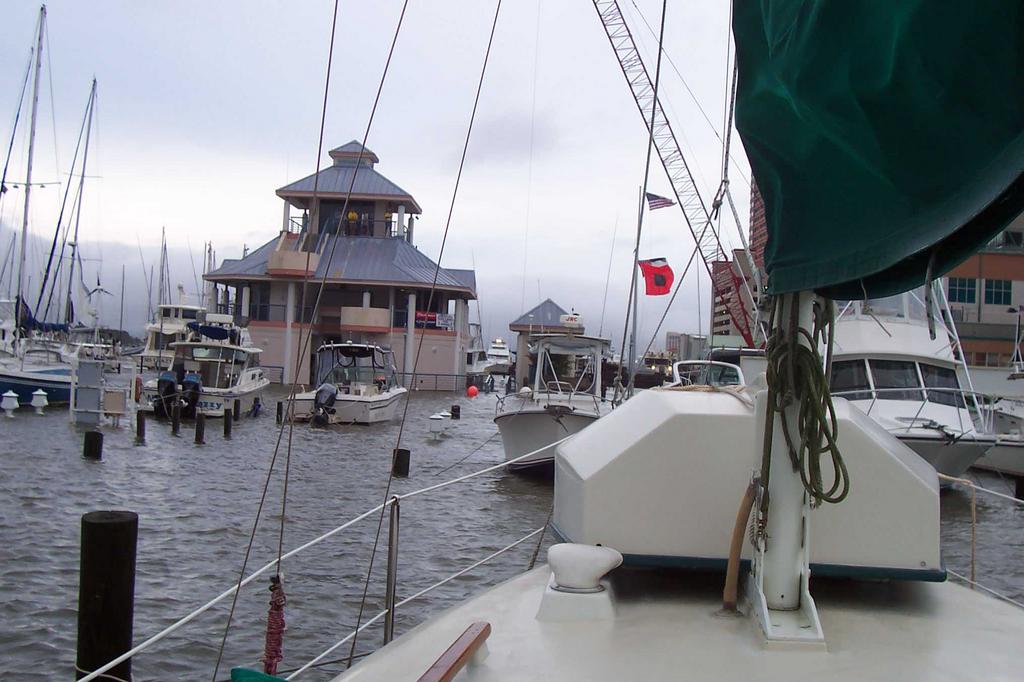
This photo was taken shortly after daylight on July 6, when Point Cadet Marina in Biloxi was still submerged by the storm surge from Tropical Storm Cindy.

It's been awhile since I've posted anything new here, mainly due to having to deal with more storm threats on the coast, which is amazing for this early in the year. Tropical Storm Cindy was making it's way across the Gulf the evening of the 4th of July, so the next morning I had to rush to Biloxi to secure Intensity. There wasn't enough warning time for the marina to try to enforce a mandantory evacuation, so when I got there 95% of the boats were still there and the owners were preparing them to ride it out at the docks by doubling up lines and putting out fenders and such. Landfall was forecast to be sometime before dawn, but the storm wasn't expect to do much, other than cause a 4-5 foot storm surge near the center of circulation. I planned to spend the night on board to keep an eye on my lines and to watch Halcyon, my friend Artie's 27' Pacific Seacraft. Artie was visiting family in Chicago and couldn't get a flight back in time to prepare for the storm.

Thankfully, I decided at about 10:00 p.m. to move my truck to the second floor of the parking garage. It was a good thing I did, as the storm did pass directly over Biloxi and we got the full brunt of the storm surge at Point Cadet. Hearing wind howling in the rigging of dozens of sailboats and someone's roller furling genoa being torn apart with vicious popping noises that sounded like gunshots, I stuck my head out of the hatch at 4:30 a.m. to find that we were experiencing a storm that was right on the verge of a Category 1 hurricane. Much to my surprise, I was looking down at the tops of the dock pilings, as the water was nearly 3 feet deep over the concrete docks of the marina. It was quite unsettling to see all the boats in the marina floating well above the docks, their lines disappearing at a downward angle to the submerged cleats they were secured to. Beyond the seawall surrounding the marina, angry waves were racing through the channel and a rise of one more foot of storm surge would have left the marina vulnerable to them, probably resulting in disaster for most of the boats. As it was, many of the vessels I could see from my vantage point in the driving rain were straining to come loose and some were heeled over almost to their beam ends by the 60-70 knot sustained winds we were experiencing. Looking over into the parking lot, I could see that the folks who left their cars there and on the ground level of the casino parking garage would regret it. The water was half way up the doors on most of the vehicles I could see.

Shortly after daylight, the eye passed over our location and the winds became calm, then resumed their fury from the opposite direction (west) as the storm moved on along it's path. Few boats were damaged other than torn biminis and sails on the ones the owners didn't secure.
I had no problems with Intensity and Halcyon was fine as well. Later when talking to Artie, however, I learned that he had left his car on the first floor of the parking garage when he caught a ride to the airport. It was unfortunately flooded, but like all real sailors, his boat was his priority and he had forgotten to mention the car to me the night before.

With all the meter boxes submerged, Point Cadet was now without power for an indefinate period of time. This was not a good situation with Category 4 Hurricane Dennis bearing down from the Caribbean with a projected path to the northern Gulf coast in just a few days. Not having power would make it hard for many boat owners to top of their batteries and prepare for the coming mandantory evacuation, not to mention the inconvenience the liveaboards would suffer in the sweltering July heat with the ability to run their air conditioners.

I was faced with several more days of hurricane preparations myself, and needed to make a decision about where to take Intensity.

Sunday, July 03, 2005

More "Island Time" in store for this year...

Although I planned to do a lot of local sailing out of Biloxi this year on Intensity, that hasn't happened as much as I hoped. Instead, I keep getting totally unexpected offers to go places I had no intention of visiting this year. Sitka, Alaska for one.... that was a great trip and a chance to see a coastal area I had long wanted to see and hope to someday explore at length. I certainly didn't start the year off thinking about a trip to Alaska, considering all the other projects I have going on, but I'm glad I went.

Hawaii wasn't on my list of places to visit either, but now it looks like I'm going to Maui sometime before Thanksgiving. This opportunity came about as a result of the Alaska trip. A friend of the yacht owner in Sitka saw the work I did there last week and has asked me to go to Lahina Bay to fabricate and install some teak covering boards (or caprails) around the cockpit of a 29' sportfisherman he keeps there for winter use. It seems these Alaska residents are used to the necessity of flying everything and everybody in and out, so it's no big deal to fly a boat carpenter in from somewhere as far away as Mississippi. It's okay by me. Like Alaska, I've always wanted to check out Hawaii anyway, so I'll be packing a tool kit as soon as I can figure out the best time to go by the Thanksgiving deadline.

Key West is another place I didn't plan to see this year. Unlike Alaska and Maui, I've been there plenty of times, both by kayak and by road. This time, however, I'll be sailing there with a friend I met at the marina in Biloxi last year when he arrived there from Texas on the start of an open-ended cruise. Artie Vaughn sails an immaculately-kept and well-equipped Pacific Seacraft 27 named Halcyon. He plans to winter over in Key West and possibly go on to the Bahamas. He doesn't particularly like single-handing on long passages like a crossing of the
Gulf, so he's asked me to help him take her across on a rhumb-line passage from Biloxi to Key West. This should be a great trip. We will likely leave the 3rd week of October, or thereabouts, depending on hurricane activity this year and the water temperature of the Gulf.

Monday, June 20, 2005

Small Boat Sailing & Beachcruising


Dealing with hurricane evacuations, boatyard haulouts and bottom jobs, not to mention monthly slip rentals sometimes makes me wonder why I ever quit kayaking and small boat sailing and "moved up" to a boat with a deep keel that has to be kept in the water all the time. There's a lot to be said for a boat that can be brought home on a trailer and forgotten about when it's not needed between trips. Here's an article I recently wrote about the appeal of sailing these kind of boats on multiday camping trips. Some people call this kind of sailing "Beach Cruising."

Beachcruising Under Sail

Mississippi’s barrier islands, lying just at the edge of visibility across the sound on a clear day, are an irresistible lure to owners of all types of boats along the mainland shore. Since camping is permitted on the beaches of all the islands in the Gulf Islands National Seashore except for West Ship Island, you don’t have to have a large boat with sleeping accommodations to spend a weekend “on island time.” Many powerboaters already know this, and on fair weather weekends it’s not uncommon to see dozens of small boats of every description either beached or anchored near shore, with tents and sun shelters erected on the sand nearby. Although I have personally made dozens of extended trips to the islands by sea kayak and aboard my 26-foot cruising sailboat, some of my most memorable trips have been on small open sailboats more commonly used for daysailing near shore. Using such a boat for extended overnight trips is often referred to as “beachcruising,” because you can get in close to shore in shoal waters other sailcraft cannot reach and you use the beach for camping at night.

The variety of small sailboats suitable for beachcruising is almost endless. Some of the smallest daysailors, of course, don’t have the load-carrying capacity for this kind of sailing, but almost any sailboat that can carry 2-3 people can be modified for beachcruising, provided the basic design is seaworthy enough to handle a chop. Open sailboats without decks provide no built in storage for gear or shelter for the crew, but can still be suitable for beachcruising with the right gear. Today’s ultralight camping gear and the absolutely waterproof “dry bags” that have been developed for sports such as sea kayaking and whitewater rafting, make it possible to carry everything you need for comfortable camping in an open boat with assurance that your sleeping bag, clothing and food will still be dry when you arrive at your campsite. With this sort of gear it’s even possible to beachcruise on boats as spartan as the ubiquitous Hobie Cat catamaran by lashing the dry bags to the trampoline. Long coastal trips have been made by adventurous sailors using such an arrangement, so an overnight trip to the barrier islands is not out of the question for most open sailboats.

Some small sailboats are designed specifically with beachcruising in mind, and come with built-in watertight storage areas and at least partial decks to improve seaworthiness and make it easier to carry gear. These boats are optimized for overnight traveling and despite the lack of a cabin have many of the safety features found on larger cruising boats, such as self-bailing cockpits and ample ballast for self-righting. Some are even designed for sleeping on board under a boom tent or other collapsible shelter, which still qualifies as beachcruising because you can usually anchor such a small boat right up near the beach in the shallows that other boats can’t enter.

In addition to a seaworthy boat, basic camping gear and a way to keep it dry, you will need navigation and safety gear such as a hand-held GPS receiver, a compass, a hand-held VHF radio, an anchor or two, oars or a small outboard for back-up propulsion if the wind dies, signal flares, PFDs for everyone on board and other basic boating gear.

The catamaran shown in the photos is a simple, yet seaworthy and fast James Wharram design that I built myself several years ago. It is 17-feet wide with a 10-foot overall beam and weighs only 250 pounds unloaded. It has a load-carrying capacity of 550 pounds of crew and gear, and can sail at speeds up to 12 knots in the right conditions. The hulls are segmented into multiple storage areas by watertight bulkheads, adding to the safety of the design and allowing one to carry everything needed for extended beachcruising trips. On board this boat I have sailed to all of the Mississippi barrier islands as well as explored areas of Florida’s coast. There’s nothing quite like skimming along at speed over the flats north of the islands, knowing you can go anywhere you like with a draft of only 12 inches.

There are many excellent resources available in print and on the web for those interested in learning more about beachcruising. Two excellent books are Douglas Alvord’s Beachcruising, International Marine Publishing, 1992, and Ida Little’s Beachcruising and Coastal Camping, Wescott Cove Publishing, 1992. The Small Craft Advisor is a print magazine for small boat sailors with an informative website at: http://smallcraftadvisor.com. For more information on James Wharram catamarans go to http://www.wharram.com.

Saturday, June 18, 2005

Preparing your Boat for Hurricane Season

(Note: I wrote the following article for South Mississippi Outdoors and Recreation)

If you own a sailboat that is too large to easily bring home on a trailer and you must keep it in the water year-round on the Gulf Coast, you need to seriously consider what you will do when the next hurricane approaches. Boats often fare worse than buildings when these storms strike the coastline, getting seriously damaged, sunk, or destroyed. You can minimize the chances of this, however, if you take the time in advance to make a plan and to equip your boat with the storm survival gear you will need.

In most marinas, particularly those located “out front” on the Mississippi coast, it is not safe to leave your boat tied up in the slip during a hurricane. The marina will require an evacuation of all boats if the forecast suggests a strong enough storm is approaching. In such a storm the water will rise several feet above normal levels and boats in marinas are subject to damage by breaking waves that wash over seawalls because of this water rise. The other danger is from the docks and pilings themselves, which can quickly destroy boats that are slammed against them in storm conditions. Plan to evacuate your marina early at the approach of a hurricane.

The first step in your hurricane plan should be to have a list of everything that is necessary to move your boat and make sure these things are on board before hurricane season arrives. You will need full tanks of fuel for your auxiliary engine, fuel for your cooking stove, drinking and cooking water, food and snack supplies for the time underway while evacuating, and such supplies as batteries and spare parts for all important systems on board. You should equip the boat with supplies for a trip of at least a week, because after a hurricane hits the area, it is often impossible to return to the marina for several days in the aftermath.

With these basic supplies on board, you now need to think about how you will secure your boat in the storm. Even in a protected bay or bayou you may experience strong winds that will tear your boat loose from your standard cruising anchor. You should have on board no less than four anchors of the appropriate size for your boat. The anchors should be designed for the bottom conditions where you expect to take refuge. Some are best for mud and sand bottoms; others are designed to work well in grass or rock. At least one of these anchors should be a greatly oversized storm anchor.

Each anchor should be accompanied by its own dedicated anchor rode, consisting of the right-sized nylon rope or chain, or a combination of both. If your boat does not have an adequate number of sufficiently strong cleats for securing all these anchors, be sure to install them before a hurricane threatens. All cleats and deck hardware should be reinforced with backing plates under the deck. Many well-anchored boats are lost because hurricane force winds tear hardware right out of the decks.

In addition to the anchors and rodes you have on board, you should have several extra-long lengths of heavy nylon line for securing your boat to trees and other solid objects ashore. These lines cannot be too long. Even in a wooded bayou, your draft may prohibit you from getting close to such objects on shore. I suggest carrying four such lines at least 200 and preferably 300 feet long for a hurricane evacuation. You will also need anti-chafing gear, which you can make yourself from pieces of an old plastic garden hose. Without some protection against chafe, even brand new lines can quickly wear through and part at their attachment points on deck in the extreme strain they will be subjected to in hurricane conditions. Otherwise well-secured boats are often lost this way.

All these anchors, extra lines and supplies cost money, but if you keep your boat in a place likely to get hit by a hurricane, look at it as the best insurance money can buy. The important thing to remember is to act early. These items should be a part of your vessel’s essential gear. Don’t make the mistake of waiting until a hurricane is bearing down across the Gulf to go out and shop for extra anchors and line. The shelves of the marine and hardware stores will be cleaned out by all the unprepared boaters buying this stuff up in a panic and you’ll wish you had gone ahead and spent the money on it when you could have.

The recent threat of Tropical Storm Arlene was a wake-up call and a test-run for many boaters on the Mississippi coast. If you’re not prepared already, now is the time to get it done before the real thing comes.

Trying to Reason with Hurricane Season

Even before the official beginning of hurricane season we've already been under the threat of a tropical storm on the northern Gulf coast. Last weekend, despite being sick for two weeks with some kind of chest congestion I was afraid might develop into pneumonia, I had to rush to Biloxi to secure Intensity as Tropical Storm Arlene was bearing down across the Gulf.

Last year's monster storm: Hurricane Ivan, understandably has made a lot of folks along the Gulf coast nervous about hurricanes, but some of these people over-reacted regarding the relatively insignificant threat Arlene posed. Arlene never quite reached hurricane status, and stayed right on the predicted track across the Gulf to make landfall around the Alabama/Florida line. Since it passed well to the east of the Mississippi coast, we barely got any rain out of it and just a few strong wind gusts of maybe 30-40 knots. I stayed aboard Intensity in the marina, as did many of my neighbors, and with doubled-up dock lines felt I would be fine there if if a storm of this strength made a direct hit.

The Friday before Arlene arrived a lot of folks panicked, and the marina where I keep Intensity ordered a mandantory evacuation. Evacuation was not really an option at such last minute notice for a lot of us who live far from the coast. Feeling the way I did from two weeks of coughing and not being able to work, I knew I wasn't going to be able to make a frantic dash for Back Bay and the bayous and go through the routine of setting four anchors, tying off to trees, etc. I felt confident the forecast track was correct and waited until Friday night to drive down. I found that several of the liveaboard boat owners in the marina refused to evacuate as well, and by the time I got there the harbormaster had unofficially retracted the evacuation order, as by then everyone was confident that Arlene was not going to be a serious threat.

Hanging out down below during the light rain the next day that was all we felt as Arlene passed by well to the east, I put together an article for my monthly piece in South Mississippi Outdoors and Recreation about preparing your sailboat for a hurricane evacuation. In my experience during these storm threats, I find that only a small percentage of boat owners actually have the gear on board that they will need to secure their boats, and many do not even think about it until it is too late. Nothing on board is more important, in my mind, than proper ground tackle and other gear to secure your boat, especially if you keep it in a hurricane-prone area like anywhere on the Gulf of Mexico. Keeping a boat in such a place can be a real headache during hurricane season, but it will be a lot less stressful if you and your boat are prepared in advance.

Sunday, May 22, 2005

Listen to the Eagle Radio Show

Ernest Herndon and I will visit the Listen to the Eagle radio studio with Eddie McCalip tomorrow night (Monday, May 22) to talk about our books and about paddling in general. Listen to the Eagle is a live, call-in radio talk show hosted by Paul Ott and broadcast over most of Mississippi through several affiliate stations.

The show usually ranges over a wide variety of topics, mostly hunting and fishing, depending on the callers. Ernest and I may only have a few minutes on the air or a lot more time, depending on how things go. Last year Paul Ott followed our Pascagoula River trip closely and we called in to the show a couple times from the river with our cell phones. Many of the callers as well as the host himself are not all that familiar with the capabilities of kayaks and canoes, and regarded our downstream river trip as some kind of feat. I'm not sure how they'll react to the concept of paddling off to the Caribbean alone in a sea kayak! I think 2 or 3 copies of my new book On Island Time, will be given away on the air to callers, and probably one of Ernest's books as well.

Eddie McCalip, who does a lot of the interviewing as well as camera work for the television version of the show is an avid paddler and his enthusiasm for rivers has helped bring attention to our Pascagoula trip and subsequent book.

Here is a link to the Listen to the Eagle website for more information:http://www.listentotheeagle.com/radio.html

Affiliate stations and broadcast frequencies are listed there, as well as a link for listening live online. The show last from 6 to 8 p.m. CDT, Monday, but I don't know for sure at what time during that slot we will be on the air.

Sea Kayaking is big business in Florida

Back when I paddled south along the Gulf coast of Florida on the sea kayak journey that eventually took me to the Caribbean, seeing other sea kayakers was a rare event. Today kayakers are everywhere. Well, maybe not so many traveling in touring kayaks, but at least there are a lot of day paddlers out there, especially on sit-on-top models and other recreational boats.

I spoke to some paddling clubs shortly after returning from my trip, both in north Florida and in Mississippi and Louisiana. All of these at the time consisted of mixed groups of kayakers and canoeists. Now there are plenty of dedicated sea kayaking clubs scattered throughout the Deep South and especially in Florida.

After sending out press releases to some of these about my new book: On Island Time: Kayaking the Caribbean, I've been invited to speak to some of these paddling enthusiasts, like the Tampa Bay Sea Kayakers, who I will visit in July. Tampa is really where I began the journey after my false start in Mississippi, so this should be an interesting place to start talking to other paddlers. I plan to focus my discussion on solo paddling, since this seems to be a fascinating subject for most kayakers, even if they have no plans to ever paddle alone themselves. The folks at Florida Bay Outfitters in Key Largo have invited me to come down and sign books at a weekend kayaking event they host in February. That should be a fine time to spend a few days in the Keys. I'll take my trusty old Necky Tesla (the same boat in which I did the trip) and plan to paddle somewhere and camp a few nights while I'm there. It would be cool to revisit some of the hidden campsites where I stayed on the original trip.

In the meantime I'll be working to stir up more interest in the book and in solo sea kayaking in general, and plan to meet with and speak to a lot more paddling groups anywhere there is an interest.

Tuesday, May 17, 2005

Only Sea Kayak in the Wooden Boat Show

My Pygmy Boats Arctic Tern was the only sea kayak on display in the Gulf Coast Wooden Boat Show this past weekend. Last year there was a gorgeous woodstrip sea kayak as well as a couple of woodstrip canoes. It always amazes me how little interest there is in paddle sports on the Mississippi Gulf Coast. Although there are certainly more kayakers now than there were back in the mid-1980s when I began paddling there, sea kayaking just hasn't caught on in a big way like it has in other areas. This is surprising, because as I point out in my book Exploring Coastal Mississippi, this area, in my opinion, offers the best sea kayaking to be found on the Gulf of Mexico, due to the distance our barrier islands are from the mainland, as well as the number of them and the availability of good campsites.

There were a few small sailboats in the show, as well as a good variety of larger wooden yachts, both power and sail. Quite a few folks showed up and took home copies of On Island Time as well as Exploring Coastal Mississippi. If I can find the time to do the work to get it up to show condition, I might take my Wharram Hitia 17 catamaran to the show next year. Like all boats, it needs constant work and is due for a paint job as well as some minor cosmetic epoxy work.

Friday, May 06, 2005

Gulf Coast Wooden Boat Show: May 14-15

The annual Gulf Coast Wooden Boat Show will be held the weekend after next, May 14-15 at Point Cadet Marina in Biloxi. The show opens at 10 a.m. on Saturday until 6 p.m., and again from 10 a.m. Sunday until 5 p.m.

Larger wooden boats on display at the show will be docked at A-pier in the marina, which is all the way to the east end. Small trailerable boats, canoes and kayaks, and vendor booths will be set up on the grounds north of A-pier and behind the J.L. Scott Aquarium.

I'll be there signing books: Exploring Coastal Mississippi, Astray of the Herd, and On Island Time, and Michelle will be there at my booth selling some of her hand-crafted jewelry and sterling silver jewelry from Mexico. Capt. Charley (see previous post about Traditional Marlinspike Seamanship) will also have some of his ropework on display at our booth and will be taking orders for rope matts, Turks Head's, etc.

This is a good opportunity to come out and look at some beautiful boats, and maybe even buy one if you've got some extra bucks you need to get rid of.

Sitka was great!

I'm back from Sitka, Alaska now, and can report that the trip and the job went smooth and turned out better than expected. Sitka is a fascinating place, an isolated little fishing community of about 9,000 people located on the Pacific side of Banarof Island, which is largely a wilderness island defined by the jagged snowy peaks of the coast range and dense conifer forests inhabited by large populations of brown bears and Sitka deer.

While there I had as my accomodations the 90-foot motoryacht, Gloria, that I went there to work on. The yacht is docked right near the heart of downtown Sitka in a municipal harbor, with fantastic views of snow-capped mountians all around. The vast majority of boats in this and other harbors in Sitka are commercial fishing vessels. Practically all the boats there, from the smallest runabouts on up are set up to handle bad weather and especially rain, most having generous dodgers or pilothouses of some sort to provide shelter for the operator. Gloria, of course, being such a large yacht, offered lavish accomodations and a large, well-equipped pilothouse high up on the bridge where the captain has a commanding view of the decks and surrounding waters.

My work involved sanding about 300 square feet of teak decks in the main aft cockpit, on the swim platform, and the steps leading up to the bridgedeck, fly bridge, and crow's nest. All the seams in these 20 steps had to be reefed out and re-caulked, adding considerable time to the job that would not have been possible to complete in the time I had there if the owner had not helped me the last three days with the work. The decks were fairly weathered, requiring us to begin sanding with 36-grit discs on the Fein 8-inch sander, but by the time we took it through the progressively finer grits of 60, 100 and 150, they looked almost new again and the owner was pleased to see that the planking was still thick enough for at least a couple more such treatments.

Deck sanding is without doubt brutally hard work, due to being on your hands and knees all day and handling powerful vibrating sanders. But despite 8-9 hours of this everyday, I still found the energy to go hiking every evening after dinner. The good thing about Sitka being located at 57 degrees north is that at this time of year daylight lasts until after 9 p.m. I used the last two hours of light every day to explore a different trail.

More about the outdoor recreation opportunities around Sitka in an upcoming post after I write an article about the area for South Mississippi Outdoors and Recreation.

Thursday, May 05, 2005

Traditional Marlinspike Seamanship

Here' s an article I wrote for the Sun Herald's South Mississippi Outdoors and Recreation magazine about one of my neighbors at Point Cadet Marina.


Captain Charley: A lifetime working with ropes

“With old sailors it was, and is, a matter of pride to be able to make knots, the more difficult and obscure the better.” Page 323, The Ashley Book of Knots

Captain Charley Strickland, Ret., is a seaman, and by his estimation, being called by that term is the highest honor anyone could bestow upon him. He was born in a tarpaper shack in Hardin County, Texas in 1938, and like his father and grandfather and most of the men in his family, soon found his way to sea. His first job was aboard a tug working the Gulf Coast of Louisiana and Texas, and that’s where he began his apprenticeship as a seaman.

From day one on board his first vessel, Charley learned the importance of rope. “Rope is literally the ‘lifeline’ of every vessel and is the most essential equipment on board” Charley says. His first job on board the tug was to make the rope fenders necessary to bring the boat alongside another vessel or a dock without damage, and to this day he prefers these “seaman-like” fenders to the inflatable plastic ones most modern boaters buy from discount stores. He learned to make the massive bow and stern pieces called “bow pudding” and “stern pudding and learned to make the traditional “monkey’s fist” knot in the end of a heaving line that enables one to throw it to another crew member on a dock or other vessel even in high winds. He learned to tie bowlines and clove hitches and make eye splices, end splices and short splices for joining two pieces of rope. In addition to these everyday knots in constant use aboard a working vessel, he learned to tie the more elaborate and obscure endless knots called “Turks heads” and to make plaited mats of rope.

Captain Charley’s career on working boats included holding practically every position on board a vessel at one time or another. He has worked as a cook, chief engineer, able-bodied seaman, mate and master. As a captain, he worked all over the southern Gulf of Mexico, operating for years out of such ports as Ciudad del Carmen, Dos Bocas, and Tampico. Although he left the sea for awhile to work on high steel as a master rigger on a construction job, his love of boats soon overcame the appeal of higher pay and he found his way back to his beloved Gulf. Captain Charley believes that seaman are made, not born, and that most men that have it in their blood would work for free if that’s the only way they could go to sea. He admits that being a seaman can be a lonely life, and that it’s hard to be a family man and spend a life at sea. He’s been married several times, but now lives with his dog, Hobo, on a small sailboat that he hopes to soon trade for a larger one that will be a more comfortable home. He also plans to voyage back to the Mexican coast he knows so well when he acquires and properly equips his new boat.

To Captain Charley it’s an atrocity to see a boat improperly tied up and to see so many modern sailors who have little regard for their boats or for taking care of the lines on board them and learning to tie proper knots. He says he looks at a boat the way a younger man looks at a woman, and that he’s never seen an ugly boat. “If anybody thinks it’s ugly, let it pull alongside when he’s sinking…” he says.

Captain Charley is adamant that anyone who goes to sea should know how to tie a variety of traditional knots and should have a splicing fid on board to make splices. He’s happy to teach anyone who shows the slightest interest in seamanship. There’s nothing he would rather do with is his time than teach his craft, especially to youngsters, as he believes these skills are a dying art.

Captain Charley can be found most any day at Slip D-39 in Point Cadet Marina. He may soon trade up to that larger boat, but you’ll know which one is his by the rope mats on deck and the monkey’s fist knots hanging from the boom. Anyone who is interested in learning more about traditional marlinspike seamanship can talk to Captain Charley at the Gulf Coast Wooden Boat Show on May 14-15. He’ll be there displaying a variety of rope mats, decorative knots, and even his version of knot art in the form of rope sculptures.
Sunday, April 17, 2005

Sitka, Alaska

I'm leaving tomorrow for Sitka, Alaska. This trip was the result of an email out of the blue from a boat owner there who found my Teaksmith Marine Carpentry page on my website and wanted to know if I would be willing to come there and do some minor repairs and sanding on his deck. The vessel is a 90-foot long-range fisherman motoryacht, but the teak decks are only in a small area of the cockpit. I expect the job to take about 3-5 days, and hope to have some spare time to do some sea kayaking and hiking while I'm there. Sitka is surrounded by wilderness, so options for exploring are many. If I can find access to the Internet while I am there, I'll post updates here about what it's like.

Online Articles at Page Wise

Pagewise.com is an online content provider that buys a wide variety of articles on a vast range of subjects. I've written about 70 articles for this company in my spare time. They now have provided author pages that index all the articles written by each author working for them. Here's a link to my author page, and from there you can click on the title of any of the articles to read them in full: http://www.pagewise.com/authors/scott-williams.htm

Most of the articles I've written for this company have been about boating, camping, canoeing and kayaking, and boat and house maintenance. Since they let the writer pick the topic, I usually write about something I already know enough about so that no research is required.

Sunday, April 10, 2005

On Island Time is finally here...

Almost 17 years since I embarked on my solo sea kayaking voyage to the Caribbean, I finally have a copy of my book about the adventure in hand. When I left on the trip I had no plans to be a writer and certainly little experience, other than college English classes, a technical writing course, and the usual required term papers for various subjects. I did often dream about being an adventure writer when I was growing up on a steady diet of jungle novels and travel narratives, but forgot about it until many years later.

While underway on the trip, many people I met in passing asked if I was going to write a book about my journey and I usually said I probably would. I kept a detailed daily journal and sent segments of it to my friend Ernest Herndon on a regular basis, so he could write a series of articles about the trip for the McComb Enterprise-Journal, where he worked full time as a reporter. He liked the journal entries and encouraged me to write. I was later contacted by the editor of Sea Kayaker magazine, who requested a narrative-style article about the trip. This was published and I became excited about writing for a while and wrote several more articles for Sea Kayaker and in the meantime put together my book about the kayak trip, which I then titled: From Black Creek to the Bitter End: A Kayak Journey to the Caribbean. I polished the manuscript as best I could at the time through 2-3 drafts and sent query letters to a few big mainstream publishers of narrative nonfiction. Although a couple of editors expressed sincere interest, nothing happened at the time and I put the project aside as I continued traveling and started spending most of my spare time building boats.

My interest in book writing was renewed when Ernest Herndon got a contract from University Press of Mississippi for Canoeing Mississippi, his guidebook to the streams of our home state. He suggested I propose a similar guidebook for the state's coastal waters, which I did in early 2001, and this eventually became my first book: Exploring Coastal Mississippi: A Guide to the Marine Waters and Islands, released in April, 2004. Shortly after I finished the final draft of that book in 2003, my girlfriend, Michelle, encourage me to submit a proposal to my editor for my narrative of the big kayak trip. I wasn't so sure that a university press would be interested in such a book, but they were and I soon had a contract and began a rewrite from my earlier drafts written around 1992-93. Few changes were made in the content, and most of it is straight from my journals, but hopefully the more interesting aspects of the trip have been brought out while the boring and mundane parts were omitted. This is certainly the type of book that could be written in many ways, and it was a long enough trip that covering every detail would result in far more than the 254 pages the final book contains. I owe a lot to Johnny Molloy, the outdoor author University Press of Mississippi chose as an outside reader for his comments and suggestions regarding the book, and to Craig Gill and others at the press for their thoughts on the title that resulted in the present one.

There are many deserving people who helped make this trip possible who I plan to give a copy of the book to, and unfortunately there are many more I met in the islands but have no way of contacting and will likely never see again who I would also like to send a copy to. Maybe some of them will find it somewhere on a bookstore shelf and remember the reckless 25-year-old from Mississippi paddling the turquoise and white sea kayak and camping on the beach.